
On 3 November, the former mining site of Sos Enattos in Lula (Nuoro) provided the setting for a key event supporting the joint Italian-Saxon bid to host the Einstein Telescope (ET), the future third-generation European infrastructure for gravitational waves.
The meeting was attended by Italy’s Minister of University and Research Anna Maria Bernini, Saxony’s Minister of Science Sebastian Gemkow, and the President of the Autonomous Region of Sardinia Alessandra Todde, together with Lula Mayor Mario Calia and the respective Italian and German scientific delegations. Representing Italy’s research community were also the presidents of INGV, INFN and INAF Fabio Florindo, Antonio Zoccoli and Roberto Ragazzoni, highlighting the strong cooperation among the institutions supporting the project.
The bilateral proposal is based on a “double-L” configuration, involving the construction of two independent interferometers located in Sos Enattos and Lusatia. As confirmed by the Geometry Comparison Report, prepared by more than 200 international experts, this solution offers significant benefits in terms of scientific potential, cost optimisation and overall governance compared with the triangular configuration. It also gives concrete follow-up to the agreements signed in Rome in January and in Nuoro on 17 July.
After visiting the Tupeddu Ramp, the institutional delegation had the opportunity to see the SG070 superconducting gravimeter at close range. The instrument was acquired as part of the MEET project and was recently installed by INGV researchers, in its final configuration, inside the Tupeddu Gallery following a testing phase.
The instrument continuously detects even the smallest variations in gravitational acceleration with extreme sensitivity. It is part of the National Fiducial Gravimetric Network and will soon be connected to the international IGETS network (International Geodynamics and Earth Tide Service). Monitoring the redistribution of mass, underground fluids and deformations of the Earth’s crust makes it possible to study local disturbances in detail, an essential step towards ensuring the best operating conditions for ET.
The day concluded at the Mining Museum with the round table “Saxony and Sardinia: two sites for a unique European research infrastructure.” In his speech, INGV President Fabio Florindo highlighted ET’s strongly multidisciplinary nature, emphasising the decisive role of geosciences. Understanding and quantifying even the most imperceptible movements of the Earth is essential for isolating background noise and detecting the extremely weak signals originating from the Cosmos. This is a high-profile scientific commitment and a challenge taken up by CCGET (the Einstein Telescope Geophysical Characterisation Centre) and by the experimental activities currently under way in the bid area.
Useful links:
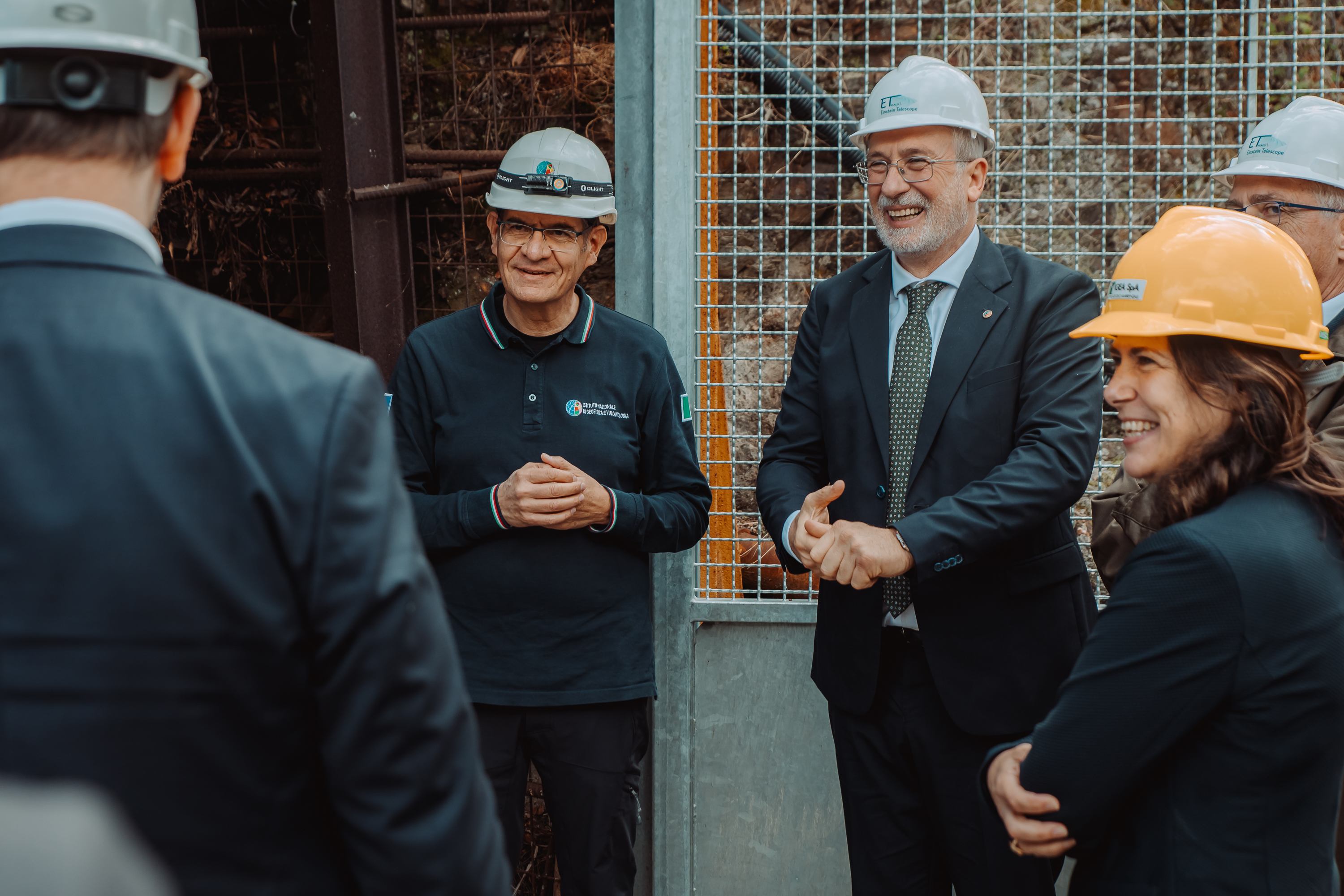
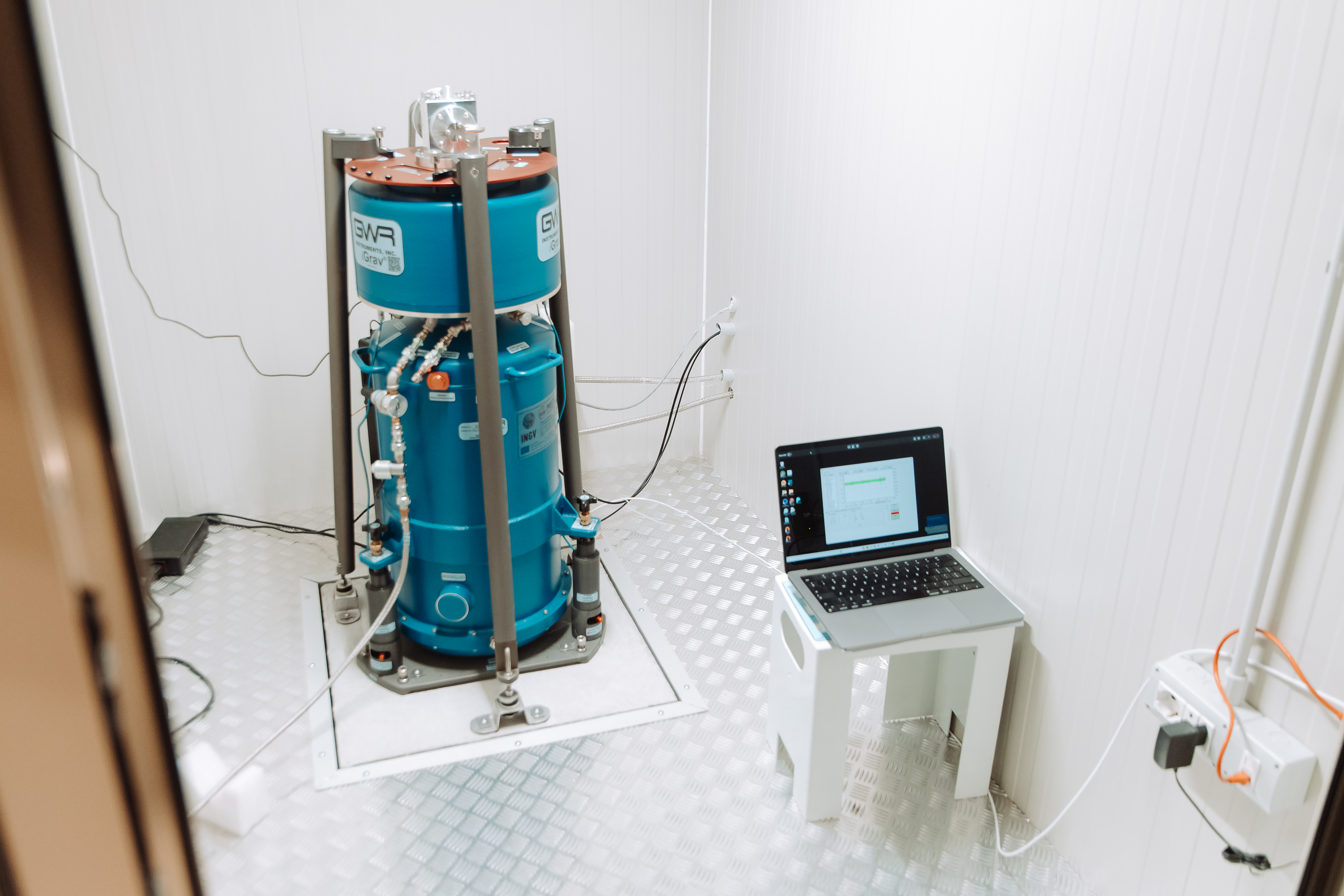 Photo Credits: Ministero Università e Ricerca