.png)
The role of CCGET
The Centre for Geophysical Characterisation for the Einstein Telescope (CCGET) is the structure established by INGV in 2025 to plan, coordinate and integrate all geophysical investigation activities at the Sardinian site. The Centre is the coordination hub for seven INGV Sections and Observatories, and works in close contact with INFN, INAF, the Universities of Cagliari and Sassari, and the Autonomous Region of Sardinia.
CCGET activities cover a broad spectrum of investigations: from seismic noise measurements using networks of temporary and permanent sensors, to electromagnetic and magnetic characterisation of the subsurface, from satellite-based ground deformation monitoring to the construction of three-dimensional geological models. Every piece of data collected will contribute to the Bid Book, the technical dossier that the Italian candidacy will submit to the international competition to host ET.
Why characterise the site
Gravitational waves are ripples in spacetime produced by high-energy cosmic events: merging pairs of black holes or neutron stars, the collapse of massive stars. These waves, predicted by Einstein in 1916 and detected for the first time in 2015 by the LIGO observatory, reach Earth with incredibly small amplitudes: the relative deformation they produce — the strain — is of the order of 10⁻²¹ (one part in 10²¹). To give an idea of what this means, it would be like measuring the distance between the Earth and the Sun with a precision equal to the diameter of an atom.
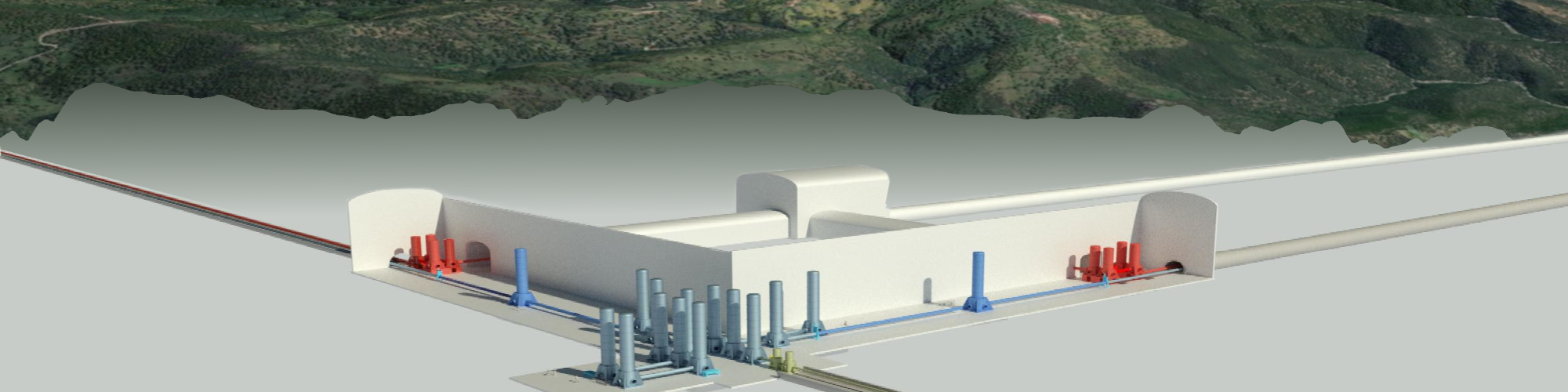
To detect such weak signals, a machine like ET must measure length variations along arms several kilometres long with an absolute precision unprecedented in the history of technology. Any ground vibration — a distant seismic wave, motorway traffic, wind shaking trees, even ocean tides — translates directly into noise in the instrument data and can mask or distort the gravitational signal. To mitigate these effects, a dual strategy is required: build the instrument at about 200–300 metres depth, where anthropogenic noise is attenuated by one or two orders of magnitude compared to the surface, and choose an intrinsically quiet site, with geologically stable subsurface and the lowest possible levels of natural seismicity.
This is precisely why the Sos Enattos area, in the heart of Sardinia, is an ideal candidate: measurements already carried out show seismic noise levels among the lowest ever recorded in Europe in the frequency band relevant to ET, between about 1 and 10 Hz. Demonstrating and documenting these characteristics with scientific rigour — and understanding everything that could influence the performance of the future observatory — is the task of CCGET. The Centre coordinates a multidisciplinary characterisation that integrates seismic, electromagnetic, geodetic and geological data to build a comprehensive knowledge of the Sos Enattos subsurface down to depths of several kilometres.
The Centre's main objectives
- Complete the large-scale geophysical investigations required for the Bid Book, the technical dossier that Italy will present in support of the Sos Enattos candidacy: seismic and magnetic noise measurements, seismic arrays, airborne electromagnetic prospecting, audiomagnetotelluric surveys, SAR interferometry and densification of the geodetic network.
- Acquire and process data for the definition of the 3D geological and hydrogeological model of the area, through integrated geophysical surveys and analysis of crustal seismic velocity variations.
- Coordinate and support activities at the Sos Enattos site, including maintenance of permanent instrumentation and support for the realisation of the multidisciplinary centre SunLab.
- Strengthen the observational infrastructure in Sardinia with the EinsteinArray network and the Sardinian component of the GIANT project.
- Monitor ground deformation using GNSS and InSAR, essential for defining the noise sources of the ET experiment.
- Carry out communication, dissemination and training activities with local communities and the general public.
- Coordinate collaborations with INFN, INAF, the Universities of Cagliari and Sassari, the Sardinia Region, and participate in the Team for ET Italia (TETI).