.png)
Airborne geophysical data acquisition campaign successfully concluded in the area candidate to host the future gravitational wave observatory
The airborne acquisition campaign of subsurface resistivity data in Barbagia — in the area candidate to host Einstein Telescope (ET), the future European gravitational wave observatory — has been successfully completed.
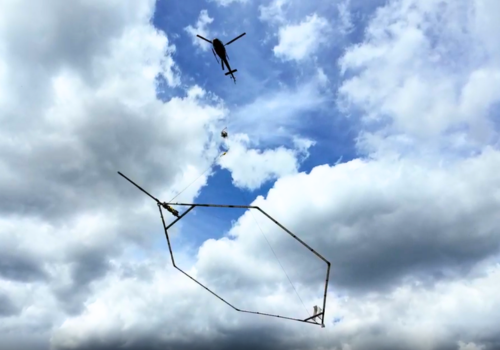
The survey, commissioned by the National Institute of Geophysics and Volcanology (INGV) and coordinated by the Geophysical Characterisation Centre for Einstein Telescope, in collaboration with the University of Cagliari, was carried out through a series of helicopter flights to acquire geophysical data using the AEM (Airborne Electro‐Magnetic) methodology — a technique that enables measurement of the electrical resistivity of the subsurface from an airborne platform, yielding images over large areas and at great depths in a short time.
The activity, which concluded on 25 May after 10 days of operations, is part of a broader geological characterisation project of the subsurface in the area, in support of the Italian candidacy to host Einstein Telescope. The survey was entrusted by INGV to a team of companies specialised in electromagnetic remote sensing, using advanced instrumentation and high-precision methodologies.
During the survey, the helicopter covered an area of 400 km², flying a total of approximately 3,000 km of flight lines. Preliminary examination of the collected data — even ahead of subsequent processing stages — has shown that in certain areas the investigation depth reached the 500 metres foreseen by the project, confirming the successful outcome of the flight operations. The acquired data will undergo specialist processing before being integrated with information gathered in the field by geologists during surface mapping campaigns, as well as with geophysical data collected in recent years by institutions and universities supporting the Italian candidacy.
The ultimate goal is the creation of a three-dimensional geological model of the Barbagia subsurface, which will serve as a fundamental tool for deepening knowledge of the area’s deep geological structure and contribute to demonstrating the suitability of the site to host Einstein Telescope.
In line with INGV’s data management policies, the final products will also be made available to local authorities and may contribute to a more sustainable use of the territory and its georesources.
Link utili:
Istituto Nazionale di Geofisica e Vulcanologia (INGV)
Università degli Studi di Cagliari
Einstein Telescope Italia