.png)
Several data acquisition campaigns, carried out using three dense networks of temporary seismic sensors ( arrays ), have allowed us to characterise the environmental seismic noise at the Sardinian site of SOS Enattos (NU), a candidate to host the Einstein Telescope , the future European observatory for gravitational waves.
The results of these studies were recently published in the international journal 'Seismica' by a team of researchers from the National Institute of Geophysics and Volcanology (INGV) , National Institute of Nuclear Physics (INFN) , University of Naples Federico II , University of Sassari and Scuola Normale Superiore of Pisa .
The data collected by the three arrays allowed the researchers to quantify and characterize the local seismic noise (natural and anthropogenic), together with the subsurface structure .
The work highlighted that the seismic noise level in the area is extremely low , with a practically homogeneous distribution of noise sources for frequencies between 10 and 20 Hz, with velocities compatible with the presence of locally generated surface waves; on the contrary, below 10 Hz, the prevalence of body waves (P and S) generated by distant sources is clear. Finally, the inversions of the surface wave dispersion curves also suggest a homogeneous subsurface characterized by high propagation velocities.
The results therefore provide new confirmation of the geophysical quality of the Sos Enattos site , confirming particularly suitable conditions in terms of low seismic noise and subsoil structure, ideal for the activities planned for the future Einstein Telescope .
Useful links:
National Institute of Geophysics and Volcanology (INGV)
National Institute of Nuclear Physics (INFN)
University of Naples Federico II
Scuola Normale Superiore of Pisa
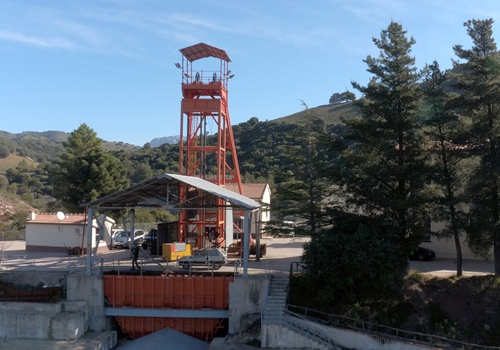
C Overview of Sos Enattos, ©EGO/INFN
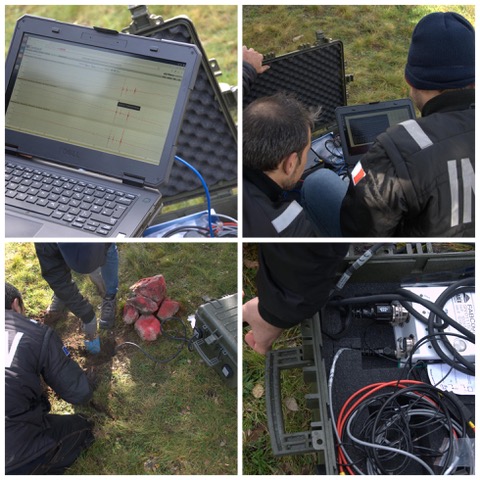
Installation of broadband seismic sensors for seismic noise studies ( photo: Maira Marzioni)
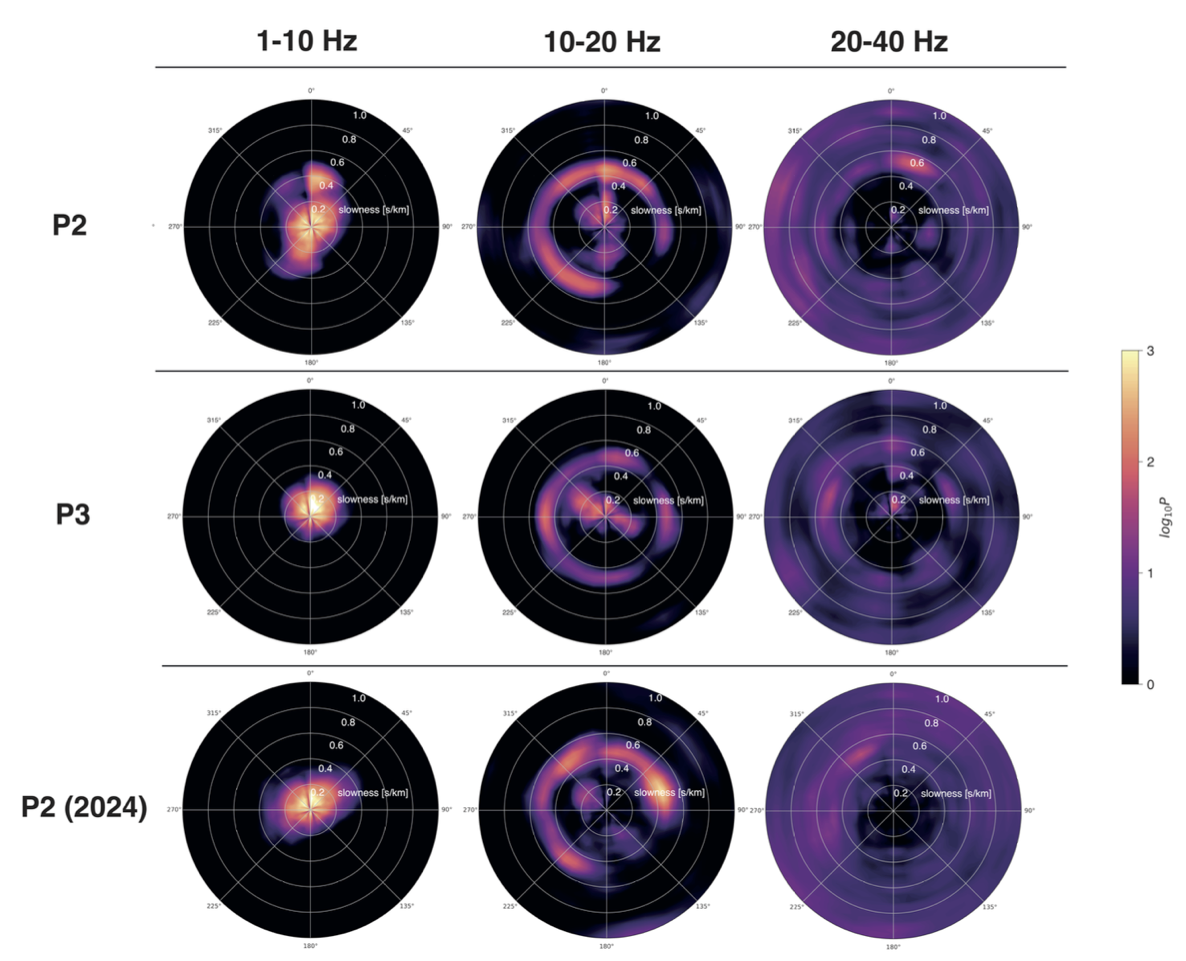
Analysis of beamforming at three arrays and in three different frequency bands.